Powers attributed to the CIS in accordance with article 3 of its Law and its Royal Development Decree
Organic structure established by the Royal Decree of the CIS for the exercise of its powers and holders of the different units
Set of rules that regulate the operation and structure of the CIS
Chronological list of the presidents of the Institute of Public Opinion (IOP) and the CIS since its foundation in 1963
National award granted by the CIS in the field of Sociology and Political Science for an academic career
The main activity of the CIS for the scientific knowledge of Spanish society is its Studies
Information on how surveys are carried out at the CIS
Main methodologies used by the CIS for conducting surveys and studies
Provisional results of the surveys prepared by the CIS
Complete collection of studies carried out by the institution, including the questions, series, and related documentation.
Integrated extraction of microdata from a set of variables for CIS studies
Public attention. Requests for information and tailor-made preparations
Comparative survey on the characteristics of citizenship in Spain
Rules and Legal Requirements for accessing and using CIS data
Access to all information regarding Publications made by the CIS
In-person and online sales of books published by the publishing unit
Dissemination of the most relevant research carried out in the field of social sciences
Open quarterly scientific periodical publication. Spanish Journal of Sociological Research. Submission of manuscripts
Compilation of the main data obtained through opinion barometers carried out over a year by this institution
Publications such as the Spanish Journal of Public Opinion (1965-1977) and dissemination of public opinion studies
Access to the main transparency and good governance contents of the CIS
Training scholarships for postgraduates wishing to take part in the scientific activity of the CIS
Grants to promote the use of the Data Bank and the completion of doctoral theses
Training courses in applied social research and data analysis for postgraduates, with tuition support
Summer courses offered by the CIS
Access to the main transparency and good governance contents of the CIS
Public employment calls managed by the CIS
Access to the Ministry's Electronic Headquarters
Access to information on CIS data protection
Procedure for the ‘Initial Deposit Plan of R&D projects with social surveys’
Channel for reporting infringements in the field of actions of the bodies of the Center for Sociological Research
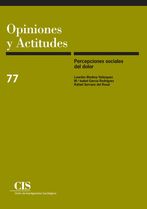
Percepciones sociales del dolor
Biedma Velázquez, Lourdes; García Rodríguez, M.ª Isabel; Serrano del Rosal, Rafael
114 págs.
Madrid, 2019.
ISBN: 9788474767971
ComprarDescripción
La International Association for the Study of Pain (IASP) define el dolor como «una experiencia sensitiva y emocional desagradable asociada a lesión tisular real o potencial o descrita en términos de dicha lesión». Esta definición viene a mostrar que el dolor es un concepto tremendamente complejo en el que, además del evidente hecho biológico, intervienen aspectos psicológicos, emocionales, sociales y culturales. El dolor, además, ha sido interpretado de forma diferente a lo largo de la historia. No obstante, la perspectiva social ha sido bastante descuidada, encontrando muy pocas referencias a la influencia de los factores sociales y culturales en el dolor.
Nuestro objetivo ha sido conocer cómo se asocian determinadas características sociales sobre el dolor, analizando la vivencia del mismo, sus diferentes significados sociales, y su sentido y legitimidad en relación con su naturaleza. Es decir, abordar la aproximación social a la experiencia de dolor, su construcción social y su percepción en la población española.
Para ello se realizó un estudio basado en encuesta con una muestra de 2.500 personas, residentes en España, de 18 años o más, a partir de un muestreo polietápico estratificado por conglomerados, a través de CAPI. Como resultados de especial interés podemos resaltar la clasificación del dolor en tipologías y el análisis del perfil social de la población en cada una de ellas. Pero, sobre todo, la clara necesidad de profundizar más en el estudio del dolor desde una perspectiva social para comprender de forma más completa este fenómeno, complementando la visión biológica, psicológica e histórico,cultural del mismo.
Manage cookie preferences
By clicking "Accept", you consent to the use of analytics cookies (which help us learn how the website is used and improve our pages and services) and tracking cookies (including from trusted partners) that help us decide what information to show you on and off our website, measure the number of visitors to our pages, and let you "Like" and share content directly on social networks. By clicking click here