Powers attributed to the CIS in accordance with article 3 of its Law and its Royal Development Decree
Organic structure established by the Royal Decree of the CIS for the exercise of its powers and holders of the different units
Set of rules that regulate the operation and structure of the CIS
Chronological list of the presidents of the Institute of Public Opinion (IOP) and the CIS since its foundation in 1963
National award granted by the CIS in the field of Sociology and Political Science for an academic career
The main activity of the CIS for the scientific knowledge of Spanish society is its Studies
Information on how surveys are carried out at the CIS
Main methodologies used by the CIS for conducting surveys and studies
Provisional results of the surveys prepared by the CIS
Complete collection of studies carried out by the institution, including the questions, series, and related documentation.
Integrated extraction of microdata from a set of variables for CIS studies
Public attention. Requests for information and tailor-made preparations
Comparative survey on the characteristics of citizenship in Spain
Rules and Legal Requirements for accessing and using CIS data
Access to all information regarding Publications made by the CIS
In-person and online sales of books published by the publishing unit
Dissemination of the most relevant research carried out in the field of social sciences
Open quarterly scientific periodical publication. Spanish Journal of Sociological Research. Submission of manuscripts
Compilation of the main data obtained through opinion barometers carried out over a year by this institution
Publications such as the Spanish Journal of Public Opinion (1965-1977) and dissemination of public opinion studies
Access to the main transparency and good governance contents of the CIS
Training scholarships for postgraduates wishing to take part in the scientific activity of the CIS
Grants to promote the use of the Data Bank and the completion of doctoral theses
Training courses in applied social research and data analysis for postgraduates, with tuition support
Summer courses offered by the CIS
Access to the main transparency and good governance contents of the CIS
Public employment calls managed by the CIS
Access to the Ministry's Electronic Headquarters
Access to information on CIS data protection
Procedure for the ‘Initial Deposit Plan of R&D projects with social surveys’
Channel for reporting infringements in the field of actions of the bodies of the Center for Sociological Research
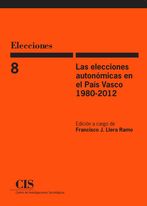
Las elecciones autonómicas en el País Vasco, 1980-2012
Descripción
Las elecciones autonómicas vascas de 2012 fueron las primeras que se celebraron sin la presencia amenazante del terrorismo de ETA, abriendo, por tanto, una nueva etapa en el País Vasco en la que, por primera vez, todas las fuerzas políticas podían competir y defender sus propuestas en condiciones de, relativa, normalidad. Por ello, son unos comicios de una gran relevancia política y que merecen una atención especial. Así, desde enfoques metodológicos muy diferentes y plurales se aborda el estudio de estas elecciones, al tiempo que se trata de cubrir una cierta laguna de este tipo de trabajos sobre el comportamiento electoral en el País Vasco, en la medida en que se le dota al análisis de una perspectiva diacrónica.
El núcleo principal de autores lo forman los miembros del equipo Euskobarómetro, a los que se les añaden profesores e investigadores de reconocido prestigio en sus respectivos campos. Están dirigidos por el profesor Francisco J. Llera, catedrático de Ciencia Política, director del Euskobarómetro y buen conocedor de la realidad política vasca, sobre la que ha escrito cerca de un centenar de publicaciones.
A lo largo de 11 capítulos se abordan aspectos clave de las elecciones de 2012. Se combinan trabajos que tratan cuestiones clásicas en el estudio del comportamiento electoral vasco, como la competición bidimensional, la participación o el peso del terrorismo, con otros más novedosos como el voto económico o las estrategias de los partidos en redes sociales y programas electorales. El resultado analítico es un todo coherente que contribuye a enriquecer el conocimiento politológico del comportamiento electoral sobre una arena política tan compleja y significativa como la vasca.Manage cookie preferences
By clicking "Accept", you consent to the use of analytics cookies (which help us learn how the website is used and improve our pages and services) and tracking cookies (including from trusted partners) that help us decide what information to show you on and off our website, measure the number of visitors to our pages, and let you "Like" and share content directly on social networks. By clicking click here