Powers attributed to the CIS in accordance with article 3 of its Law and its Royal Development Decree
Organic structure established by the Royal Decree of the CIS for the exercise of its powers and holders of the different units
Set of rules that regulate the operation and structure of the CIS
Chronological list of the presidents of the Institute of Public Opinion (IOP) and the CIS since its foundation in 1963
National award granted by the CIS in the field of Sociology and Political Science for an academic career
The main activity of the CIS for the scientific knowledge of Spanish society is its Studies
Information on how surveys are carried out at the CIS
Main methodologies used by the CIS for conducting surveys and studies
Provisional results of the surveys prepared by the CIS
Complete collection of studies carried out by the institution, including the questions, series, and related documentation.
Integrated extraction of microdata from a set of variables for CIS studies
Public attention. Requests for information and tailor-made preparations
Comparative survey on the characteristics of citizenship in Spain
Rules and Legal Requirements for accessing and using CIS data
Access to all information regarding Publications made by the CIS
In-person and online sales of books published by the publishing unit
Dissemination of the most relevant research carried out in the field of social sciences
Open quarterly scientific periodical publication. Spanish Journal of Sociological Research. Submission of manuscripts
Compilation of the main data obtained through opinion barometers carried out over a year by this institution
Publications such as the Spanish Journal of Public Opinion (1965-1977) and dissemination of public opinion studies
Access to the main transparency and good governance contents of the CIS
Training scholarships for postgraduates wishing to take part in the scientific activity of the CIS
Grants to promote the use of the Data Bank and the completion of doctoral theses
Training courses in applied social research and data analysis for postgraduates, with tuition support
Summer courses offered by the CIS
Access to the main transparency and good governance contents of the CIS
Public employment calls managed by the CIS
Access to the Ministry's Electronic Headquarters
Access to information on CIS data protection
Procedure for the ‘Initial Deposit Plan of R&D projects with social surveys’
Channel for reporting infringements in the field of actions of the bodies of the Center for Sociological Research
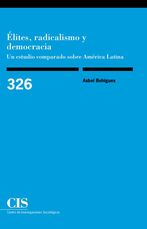
Élites, radicalismo y democracia: un estudio comparado sobre América Latina
Descripción
Este trabajo tiene como objetivo analizar el papel de las élites políticas en las variedades de democracia, con evidencias de 18 democracias latinoamericanas en el período 1995,2015. La literatura se ha centrado tradicionalmente en quiebras, transiciones y consolidación. Esta investigación va un paso más allá y se centra en las variedades de democracia (electoral, liberal, participativa, deliberativa e igualitaria), así como en la democracia plena en el sentido de un régimen que tiene altos niveles de cada variedad. El propósito es incluir a las élites políticas en la ecuación democrática en términos de su apoyo a la democracia, medido por el apoyo a las elecciones y los partidos políticos, y su radicalismo, medido por posiciones ideológicas extremas en la escala izquierda,derecha. Para ello se utilizan de manera conjunta las encuestas a élites de la Base de Datos de Élites Latinoamericanas (PELA,USAL) y Varieties of Democracy (V,Dem), adoptándose una estrategia de métodos mixtos, desde un enfoque cuantitativo (HJ,Biplot) a uno comparativo (fsQCA) para cerrar con un process tracing comparado entre dos casos representativos de los principales hallazgos del estudio, Uruguay y El Salvador. Los resultados muestran que el radicalismo de las élites está asociado positivamente con algunas variedades de democracia, como la igualitaria.Tambiénmuestran que el radicalismo democrático, es decir, las élites radicales (en las posiciones extremas de la escala izquierda,derecha) que apoyan la democracia (elecciones y partidos políticos), es positivo y no negativo para un régimen democrático que sea fuerte en las cinco variedades.
Manage cookie preferences
By clicking "Accept", you consent to the use of analytics cookies (which help us learn how the website is used and improve our pages and services) and tracking cookies (including from trusted partners) that help us decide what information to show you on and off our website, measure the number of visitors to our pages, and let you "Like" and share content directly on social networks. By clicking click here