
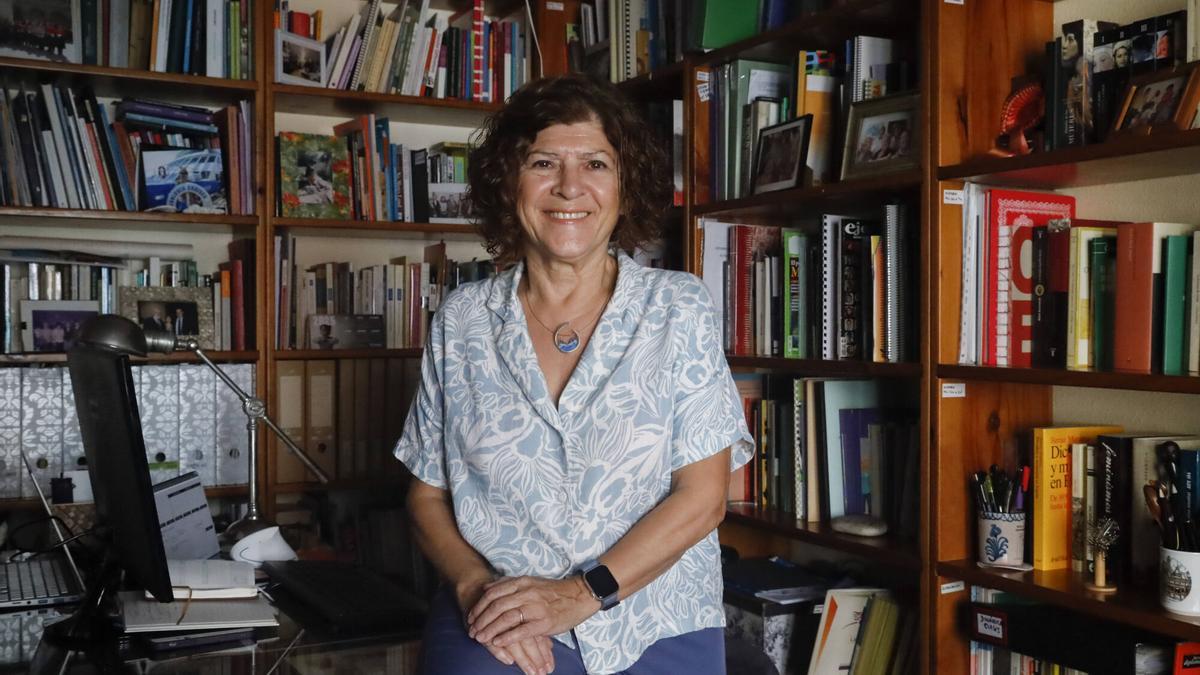
A few days before the National Sociology and Political Science Award ceremony, we spoke with Capitolina Díaz, who said she felt more excited than nervous. This was due to the prestige of the award and because her colleagues themselves had recognized her more than 30 years of work in sociology with a gender perspective, as well as her academic excellence aimed at contributing to a more just and equitable society.
“I’m thrilled with this outpouring of support and all the messages and expressions of affection. I get the impression that many people have taken the award as their own, and that’s wonderful.”
From a multidisciplinary perspective, her dedication to teaching and pedagogy has, alongside her research, contributed a series of tools—small methodological innovations—available to universities and the scientific community. Examples include the design of software, a translator of any text into inclusive language, named CaDi in her honor. She also created and implemented the so-called 'Minimum Gender Test' to ensure gender-conscious research, and has developed numerous courses and training programs to equip university staff with the tools to integrate the gender dimension into their research.
She continues to believe that “the care gap is the mother of all gaps” and warns that, in education, there is still much to be done, that secondary school is key, because it is where femininities and masculinities are formed:
“We are not educating our daughters, girls, and young women to know how to be unique and first. Not even close. Girls and women are trapped in the pressure to be agreeable. There is still a certain demand to be liked, to be kind, and that greatly limits your ability to become who you want to be, beyond the good, pretty, and agreeable girl. We believe we have to let others take advantage of that kindness. There is a certain desire to please, to help, to endure, to accompany. And meanwhile, we lose ground in what is only ours. We are not educated to occupy the center of attention. We only occupy that central space if we don't bother anyone and all our caregiving tasks are already done.”
Capitolina speaks passionately about her role models, sociologists such as Maria Ángeles Durán and Inés Alberdi, among many others. She acknowledges that their example has been an essential inspiration for continuing to identify trends, find reasons behind them, and contribute solutions.
“I believe that women who dedicate themselves to social thought do not limit themselves to describing institutions, but rather analyze how these are inscribed in concrete life trajectories; we do not study the economy as an abstract system, but as a set of material relations that produce dependence, inequality and subjectivity; we do not approach law or the family as autonomous normative spheres, but as devices that organize bodies, times and lives.”
She is a product of her time, and she is aware that, in this February of 2026, in which she is awarded the prize, discrimination against women is still seen on a daily basis; however, she is positive by nature:
“We have made enormous progress, we still need the alliance of men, and the change in the laws has already been achieved. In academia we are very present, in the judiciary and medicine our numbers are constantly rising, and also in public administrations… I remember how they laughed at us when, from the Ministry of Equality, we proposed in 2009 a 15% presence of women on the boards of Ibex companies… And today we exceed 41%…”.
And yet, “science still doesn’t love women,” she laments. “On the one hand, it expels them from universities and doesn’t select them for scientific positions. It’s run by men with a male perspective. You have to adapt to their rules, and if you deviate, you pay the price, because they exclude you from the establishment. Science doesn’t see women. You can’t love what you don’t know.”
And she confesses that, since learning of the awarding of the National Prize for Sociology and Political Science, she has not stopped reflecting and writing about the role of female research work and what is particular about its contribution to the scientific community.
“Women social thinkers gave sociology back what the canon had left out: the body, everyday life, and real inequality. Without women sociologists, sociology has been more abstract than truthful. They don't allow themselves to look from afar. They have shown that social reproduction, care work, and dependency are not 'soft' topics, but rather structures without which we cannot understand how power functions or how inequalities are produced.”
And it acknowledges the work of the Center for Sociological Research in recovering the pioneering work of women who were invisible in social science:
“I have no words to express the value of Professor Tezanos’s legacy, a vision that none of his predecessors possessed. Since his arrival, he has consistently done things to highlight the role of women in sociology: striving for parity and balance in the awarding of the Prize, recognizing our contributions, organizing conferences, rescuing, translating, and making available to citizens and institutions the work of the pioneering women in sociology. José Félix Tezanos truly had the ability to see us.”
Capitolina Díaz Martínez will receive the National Sociology Prize on February 9th from His Majesty the King.