
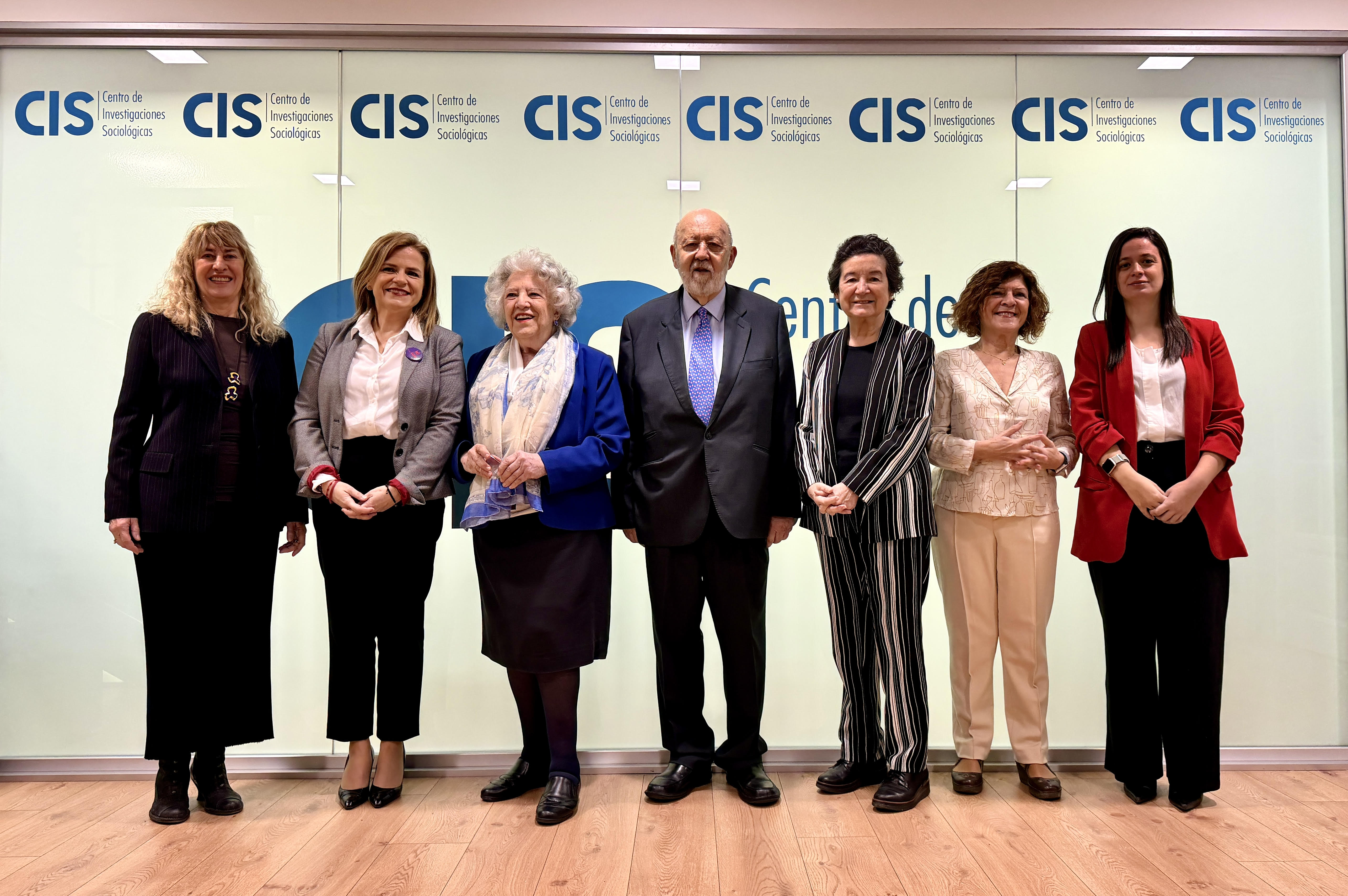
The vision of the five sociologists awarded the National Prize for Sociology and Political Science is the common thread that inspires this year's V Conference on Sociology of Gender organized by the Center for Sociological Research on the occasion of Women's Day.
The Director General of Coordination and Research at the CIS, Silvia García Ramos, defined the event as an already consolidated institutional space for debate and knowledge production around the Sociology of Gender, which is made available to all sociologists and researchers: "another example of the CIS's commitment to giving academics and social thinkers the space they deserve, to highlighting their intellectual leadership and to guaranteeing balanced representation in the public debate."
García Ramos clarified that gender equality “is not a sectoral issue nor a secondary matter. It is a structural dimension that permeates all areas of social life: employment, care work, education, political participation, science, and culture. Analyzing gender inequality involves investigating how power, resources, time, and opportunities are distributed in our society.”
“Equality is a way to enrich life,” declared José Félix Tezanos, who also wanted to convey his personal impressions after arriving at the institution and discovering that there were no female sociologists awarded the National Prize for Sociology and Political Science.
“I experienced it as a social pathology. I believe that the historical discrimination and subjugation of women, from the later stages of the Neolithic period onward, must be understood as a serious social pathology, a flaw in the formation of society. A pathology that distorts our civilization, our way of understanding coexistence, and that also distorts political behavior.”
He recalled his experience as a child “born in the year of famine, in 1946” and the episodes of contempt for women he witnessed from the innocence of childhood, before going on to observe the virtual absence of female professors in the faculties of Law, Sociology, and Political Science where he studied. “We must flee from social pathologies,” Tezanos continued. “And in contrast to them, we must strive for social normality, balance, and that is reflected in equality. Right now, we have a treasure at the CIS, which are the five award winners, and their contribution is unique and an example for society.” |
|
The Government Delegate in the Valencian Community, Pilar Bernabé García, focused her speech on the significant progress made in gender equality over the last decade. She addressed the five award winners, assuring them that “laws serve to solidify everything you research in society.”
“Throughout the 20th century, feminism has had three fundamental pillars: activism, academia/research, and legislation. Legislating, implementing public policies, and reclaiming the occupation of public space.”
She pointed out that the most progress has been made in the workplace, with the lowest wage gap in the historical series (15%), and reviewed the legislative initiatives that have advanced women in work and caregiving.
The Dependency Law and the Comprehensive Law against Gender Violence, “bringing into the public sphere what was in the private sphere, where the world was silent, and today each of us becomes a 'purple point' to be able to report abuse, and even so, we still haven't managed to flatten that terrible curve.” But also the Labor Reform, the increase in the Minimum Interprofessional Wage or the increase in pensions; the Parity Law, the future Time Use Law, the equalization of maternity and paternity leave, and the Equal Pay Law.
“Responsible and feminist governments know that equality is also at stake at the end of the month.”
Despite these advances, Bernabé pointed out that there are still many areas where much work remains to be done. And he posed a question:
|
|
“The algorithms of the digital wild west and their owners do have an ideology. And it’s not new; it’s the oldest in the world, the one that wants to take us back to the private sphere, to invisibility, to silence.”
María Ángeles Durán, winner of the 2018 National Sociology Prize, delivered a masterclass in humanity, passion, clarity, and common sense. Her story is that of a “complete sociologist.” The professor recounted her career path, from the early family and personal decisions about what she should or shouldn't study, to the sacrifices and life's twists and turns that shaped her destiny.
“I developed a sense of class consciousness right away, because I lost it when my father died. And that made me a sociologist because I was observing Spanish society simultaneously from many different perspectives.” “I have a degree thanks to two women: one who took on debts, and another who sacrificed her social standing so that I could study without the burden of family responsibilities.”
And she wove together anecdotes about professors and mentors, her first jobs, the richness of nuance in her early work as a surveyor and coder. She learned to work with hostile respondents, to be aware of her own image, to doubt her own data, to interpret nonverbal language, the unspoken codes where gesture and tone were paramount; she learned to manage the frustration of having to reduce answers to a yes or no, to be aware that, sometimes, it is impossible to transcribe a message.
The diverse fields in which María Ángeles has worked give her a multifaceted view of Spanish society: “The economy is a fiction. It’s just the tip of the iceberg: we confuse employment with work. Every hour of paid work is supported by two hours of unpaid work. And the vast majority of unpaid work hours in the world are done by women.” And she’s not optimistic. “Caregiving is incredibly expensive. We’re being overwhelmed with burdens. Why aren’t we having children? And now, on top of everything else, we have the weight of caring for the elderly…”
“We are in a very deep contradiction. And as long as we have this internal confusion of values, feminism is at risk of regressing. I keep saying: let's go for it! But feminism is divided and we have the wind against us.”