
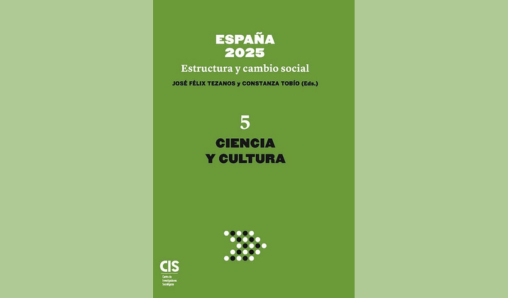
- This volume analyzes and compares the evolution of Spanish society in the last ten years in matters of science and culture
- In this volume, culture is understood in its broadest sociological sense as a set of symbolic, emotional, and ideological frameworks that shape how individuals experience their social life.
The CIS (Spanish Centre for Sociological Research) has published the final, fifth volume of the collective work 'Spain 2025: Structure and Social Change'. This concludes this ambitious publishing project, which involved 146 experts and aimed to analyze the social changes experienced in Spain over the last decade. Also published is the work entitled “Experimental Sociology: Methods, Theories, and Applications,” within the Methodological Notebooks collection (CM 65).
This book , 'Spain 2025. Structure and Social Change. Science and Culture' , is the fifth volume in the 57th series of the CIS Out of Collection. Written in a rigorous academic format, it analyzes and compares the evolution of Spanish society over the last ten years in the areas of Science and Culture, highlighting its progress, stagnation, and setbacks in various aspects of Spanish society.
In this volume, culture is understood in its broadest sociological sense as a set of symbolic, emotional, and ideological frameworks that shape how individuals experience their social lives. Identities, values, beliefs, cultural practices, the role of science and education, as well as social networks and cultural patterns, are examined.
Its trajectory allows us to observe how Spain is moving towards a more pluralistic, individualized, digitized and emotionally complex cultural model.
More news
This work is edited by the President of the CIS, José Felix Tezanos Tortajada, and Professor Constanza Tobío Soler, winner of the 2021 National Prize for Sociology and Political Science.
The five volumes (Volume 1: Social Structure; Volume 2: Social Dynamics; Volume 3: Economic Structure and Inequalities; Volume 4: Power, Politics and Society; and Volume 5: Science and Culture) address aspects such as the demographic characteristics of the Spanish population , the family and interpersonal relationships , gender gaps , the role of women , youth , housing problems, migrations , the rural world, the economic structure, employment and consumption, unemployment, social stratification and inequality, power, politics, institutions, social actors, daily life, beliefs, culture, identities, and the role of science, among others.
A new book in the Methodological Notebooks collection is also available: ' Experimental Sociology: Methods, Theories, and Applications '. This methodological notebook aims to make a significant contribution to the knowledge and practice of the experimental method in the social sciences, specifically in sociology. However, we do not intend to overlook the contributions of other branches of the social and behavioral sciences, such as political science, social psychology, and economics, whose examples of experimentation have driven experimental sociology and strengthened the idea of interdisciplinary knowledge focused on a research object. It contains theoretical and practical material for approaching an experiment, from defining the research problem and designing the experiment to statistical analysis and the research report. It draws on a diverse sample of experiments conducted internationally and interviews with researchers who have successfully applied the experimental method, highlighting its intricacies and complexities.