
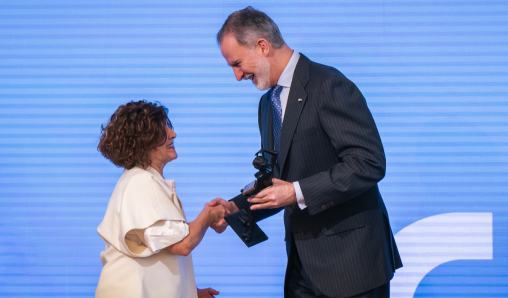
On Monday, January 9, the solemn presentation of the 2025 National Prize for Sociology and Political Science, awarded by the Center for Sociological Research, took place in the auditorium of the Royal Collections Gallery.
Capitolina Díaz Martínez , Professor of Sociology at the University of Valencia and the first woman in Spain to study Sociology of Science from a gender perspective, received recognition from His Majesty the King for an intense career of academic and research excellence.
In an event led by the Director General of Coordination and Research of the CIS, Silvia García Ramos , the President of the Center for Sociological Research, Jose Félix Tezanos, began his speech by recalling that just eight years ago, in 2018, there was not a single woman who had been distinguished with the National Sociology Prize.
Thanks to her personal efforts, the award has since been given to five women:
“ They are highly specialized academics in specific areas of Gender Sociology. Their works and research constitute seminal contributions to fields related to the gender policies being promoted in contemporary societies. Therefore, it is important to emphasize that this body of contributions forms a set of innovations and contributions to current Sociology that could in itself constitute a major Treatise on Gender Sociology, allowing us to fully understand what has happened, what is happening—and what needs to happen—in the dynamics of our societies,” Tezanos stated.
The president of the CIS also wished to express his gratitude for the support of His Majesty the King, “who year after year honors us with his presence and his example of commitment to the Sciences and the Arts, and to the most relevant conditions for political coexistence for all and among all. A King who has been fulfilling his role with a high sense of institutionalism, which is also reflected in the sincere recognition of Spanish sociologists and political scientists.”
In her laudatory speech for the award recipient, Professor Constanza Tobío highlighted the originality of Capitolina Díaz's thinking, which she termed "sociological imagination," as well as her enthusiasm and tenacity. She praised Díaz's contribution to rescuing the legacy of women sociologists of the past and focused on one of her most original and forward-thinking lines of research: the analysis of gender biases in the application of digital technology and now, artificial intelligence.
And then came the moment for the honoree's speech, which already promised much with its suggestive title: "The Social Epiphany of Women and Its Consequences for Sociology." Capitolina Díaz began by thanking and celebrating the support and inspiration of all those men and women who helped solidify her career , and who even shaped her future when she was a student and later a young professor.
The award winner reviewed how science excluded women with the acquiescence of brilliant minds and their marginalized status in countless fields, including health, with surprising examples.
And yet, at the end of that analysis, she left us with a cry of positivity: “How dare I proclaim that the women’s revolution is successful? Don’t I see the inequality that still diminishes us? (…) The feminist revolution has consisted of more than two centuries of persevering activism and theoretical creation, which have gradually imposed the presence of women on social norms and political agendas. This process has allowed us to achieve everything from suffrage to enjoying human rights and, in particular, the right to gender equality and reproductive and sexual rights. These are rights that, as they move from law to reality, have effectively made women visible. We can illustrate this visibility with clear examples from our own country: think of the women we see in cabinets, in parliament, in the judiciary, in journalism, in academia, in hospitals, driving taxis and buses, etc. Today we can see women receiving scientific awards. It is true that the Nobel Prizes, for example, are still not exclusively awarded to women.” It's true that, until very recently, only exceptional figures like Madame Curie or María Ángeles Durán received the highest honors. They were still a drop in a sea of men. However, the National Prize for Sociology and Political Science is now making the work of women sociologists visible at a similar pace to that of their male counterparts. And the same has been happening for the last two years with the National Science Prizes. For all these reasons, I believe we can be hopeful and say that women, although still facing persistent and hostile spaces of inequality, have gone from invisible to almost omnipresent.
The audience rose to their feet in prolonged applause, and the event was finally closed by the Minister of the Presidency, Justice, and Relations with the Cortes, Félix Bolaños, who emphasized the essential contribution of the Social Sciences to strengthening democracy and fostering a better understanding of Spanish society. He highlighted Capitolina Díaz's commitment to public service, underscoring her solid academic background, prolific research activity, and international standing.